 Your selected document
Your selected document
Your selected documentThis is the abstract of a study selected by Drug and Alcohol Findings as particularly relevant to improving outcomes from drug or alcohol interventions in the United Kingdom. It was not published by Drug and Alcohol Findings. Unless permission has been granted, we are unable to supply full text. Click on the Title to visit the publisher's or other document supplier's web site. Other links to source documents also in blue. Hover mouse over orange text for explanatory notes. Free reprints may be available from the authors - click Request reprint to send or adapt the pre-prepared e-mail message. The abstract is normally based on the document's own abstract. Below it are some comments from Drug and Alcohol Findings.
 Syringe disposal bins: the outcomes of a free trial for city traders in an inner-city municipality Australia.
Devaney M., Berends L. Request reprint
Substance Use and Misuse: 2008, 43(1), p. 139–153.
Abstract Community responses toward discarded syringes have the potential to threaten the sustainability of harmreductionx interventions. Many retailers in the central business district of Melbourne, Australia, have expressed concern about drug use and the associated discarded syringes. Melbourne City Council has responded to these concerns through a variety of strategies. One such strategy was a six-month free trial of syringe bins for businesses during 2003–2004. The council commissioned an external evaluation of the trial. Eighteen business representatives and six key informants undertook semi-structured interviews to monitor issues arising throughout the trial. Syringe disposal bins are a useful option for facilitating appropriate syringe disposal; 11 of the 13 businesses which participated in the trial continued with the maintenance of the syringe disposal bins beyond the free trial period.

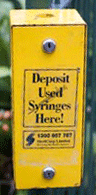 Syringe disposal units sited in public toilets and other publicly controlled facilities are not uncommon in Britain, but units sited on private premises are. When Melbourne sought to broaden access to disposal facilities, it took the unusual step of canvassing toilet-equipped city centre
business and leisure premises
Including restaurants, cafés, cinemas, department stores, theatres, gyms and fitness centres.
as well as hospitals, colleges, churches and welfare groups, offering free installation and servicing of bins. Over the six months of the trial, 62 bins were installed and some existing bins began to be properly serviced, accounting for an estimated 12,590 syringes. After the trial period, nine of the 11 businesses involved took on the costs of continuing to service 58 bins. Motivating their involvement was typically concern that customers were coming across discarded syringes and the risks for staff who had to clear them up. Melbourne now routinely offers a disposal bin service to businesses.
Syringe disposal units sited in public toilets and other publicly controlled facilities are not uncommon in Britain, but units sited on private premises are. When Melbourne sought to broaden access to disposal facilities, it took the unusual step of canvassing toilet-equipped city centre
business and leisure premises
Including restaurants, cafés, cinemas, department stores, theatres, gyms and fitness centres.
as well as hospitals, colleges, churches and welfare groups, offering free installation and servicing of bins. Over the six months of the trial, 62 bins were installed and some existing bins began to be properly serviced, accounting for an estimated 12,590 syringes. After the trial period, nine of the 11 businesses involved took on the costs of continuing to service 58 bins. Motivating their involvement was typically concern that customers were coming across discarded syringes and the risks for staff who had to clear them up. Melbourne now routinely offers a disposal bin service to businesses.
Though theoretically possible, Especially in the case of hepatitis B, least so in respect of HIV. in practice acquisition of a blood-borne virus infection due to a needlestick injury from a discarded syringe is virtually unheard of. In Australia, no such incidents have been recorded. Yet the fear that this might happen is real enough and so is the environmental degradation caused by discards and the negative impression they give of injecting drug users. Despite there being no evidence that discards increase when a needleexchangex opens, such concerns mean that discards jeopardise public support for facilities serving injectors, especially needleexchangexs. Indirectly, this makes discards an important public health issue because opposition may threaten viral control via exchanges.
Current UK government guidance acknowledges these points and potential public hostility to bins, before calling on local partnerships to "fully explore the potential for sharps bins", and in particular to ensure their effective promotion and siting. Though there is no specific call to consider non-public premises, this general recommendation would legitimise a move beyond the usual siting in public toilets. Such initiatives could build on the trend in the UK to persuade private premises managers such as pub landlords to make their toilets accessible to the public. As with that initiative, it has the potential to greatly increase access to facilities (in this case, syringe disposal bins) at relatively little cost.
Last revised 29 December 2008 Comment on this entry Give us your feedback on the site (one-minute survey)
Drug consumption rooms: an overview of provision and evidence REVIEW 2015
Consideration of the use of foil, as an intervention, to reduce the harms of injecting heroin and cocaine DOCUMENT 2010
Time for safer injecting spaces in Britain? HOT TOPIC 2019
Drug Treatment Matrix cell D1: Organisational functioning; Reducing harm MATRIX CELL 2017
'Most compelling evidence yet' that injecting rooms reduce overdose deaths STUDY 2003
Drug Treatment Matrix cell E1: Local and national systems; Reducing harm MATRIX CELL 2017
Drug Matrix cell C1: Management/supervision: Reducing harm MATRIX CELL 2017
Supervised consumption sites: a nuanced assessment of the causal evidence REVIEW 2019