 Your selected document
Your selected document
Your selected documentThis is the abstract of a study selected by Drug and Alcohol Findings as particularly relevant to improving outcomes from drug or alcohol interventions in the United Kingdom. It was not published by Drug and Alcohol Findings. Unless permission has been granted, we are unable to supply full text. Click on the Title to visit the publisher's or other document supplier's web site. Other links to source documents also in blue. Hover mouse over orange text for explanatory notes. Free reprints may be available from the authors - click Request reprint to send or adapt the pre-prepared e-mail message. The abstract is normally based on the document's own abstract. Below it are some comments from Drug and Alcohol Findings.
 Improving 24-month abstinence and employment outcomes for substance-dependent women receiving Temporary Assistance For Needy Families with intensive case management.
Morgenstern J., Neighbors C.J., Kuerbis A. et al. Request reprint
American Journal of Public Health: 2009, 99(2), p. 328–333.
Abstract This abstract incorporates additional information from an earlier journal article and from a report by the responsible research centre.
The US Temporary Assistance for Needy Families (TANF) welfare-to-work programme offers financial support to unemployed parents normally for up to five years as long as they comply with requirements intended quickly to transition the family to self-sufficiency through employment or other means. Non-compliance results in sanctions including loss of benefit. Depending on state rules, substance use treatment may be a required or discretionary component. The programme has dramatically reduced the number of welfare beneficiaries. A substantial minority of those who are left are hampered by problems related to substance use, and this group are also more likely to face other barriers to employment.
At the time of the study the typical response of US states was to refer individuals identified through screening for assessment and if appropriate to treatment, with little follow-up. The featured study compared outcomes from such an approach to intensive case management. This entailed two case managers working with each woman to motivate treatment entry, help overcome barriers, coordinate services such as childcare, housing and transport, prepare for employment, find jobs, and arrange relapse-prevention support once employed. Treatment engagement was rewarded with shopping vouchers. Case management continued throughout the two-year follow-up period of the study.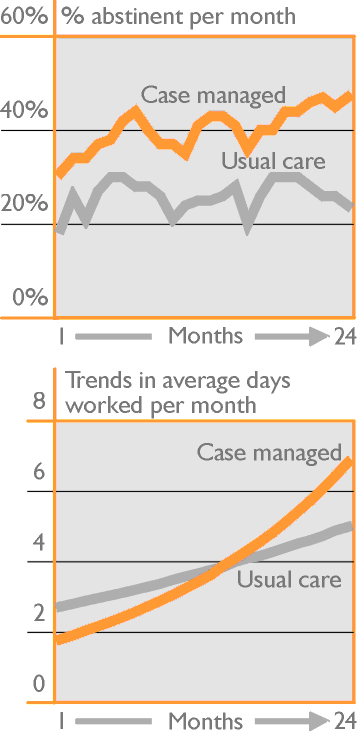
302 substance-dependent A comparison group of TANF applicants not identified as substance dependent were also recruited to the study. women identified after routine screening procedures In accordance with New Jersey regulations, welfare workers administered the CAGE-AID brief screening survey to everyone (re)applying for TANF benefits. Women who responded positively to two or more questions were referred for assessment to addictions professionals at the welfare offices who screened clients for study eligibility. were randomly allocated to usual TANF procedures or to intensive case management. Typically the women were non-injecting Opiate injectors were usually referred to methadone maintenance which disqualified them from the study. users dependent on heroin or cocaine, black and poor, had three or four children, and had not completed compulsory schooling. On average they had been in receipt of welfare benefits for 12 years. Across the follow-up period, those offered case management were over twice as likely to be abstinent during any particular month, and the advantage conferred by case management grew over the two years. By the final month 47% were abstinent compared to 24% of the usual care women. Across the entire follow-up period, case managed women did not work significantly more days per month, but they were 68% more likely to be in full time employment. They consistently achieved steeper rates of improvement in any employment, full time employment, and days worked, until by the final month they were working an extra week a month and 22% were working full time compared to just 9% after usual care. The authors concluded that intensive case management is a promising intervention for managing substance dependence among women receiving welfare benefits and for improving employment rates among this vulnerable population.
 The key findings in this study are the clear differences in trends in abstinence and,
associated with this,
Prior abstinence was associated with later employment both year to following year and month to following month. However, it is unclear whether abstinence facilitated employment, or whether having been employed earlier made it more likely that you would later both remain employed and be abstinent. In the former scenario abstinence is a contributor to employment, in the latter either a consequence of employment or simply a marker of individuals in a position to make both sorts of changes in their lives. Possibly some mixture of all these influences were in play.
in employment, promising increasing post-study gains for the case managed women, but an
uncertain future
Their continuing vulnerability to problem drug use despite work seems apparent in the fact that among women who had worked that month there was no trend to increased abstinence over the two years. In contrast, there was an increasing trend among case managed women who worked. By the end of the follow-up, more than three fifths of the case managed women who were working were also abstinent, compared to just a third among usual care participants.
for those given minimal help to enter and stay in treatment apart from the negative incentives of the TANF system. Further analysis suggested that the degree of contact with their care coordinator (for case managed women, this was their case manager) was what mainly accounted for the abstinence-fostering advantage of case management. In particular, these contacts helped improve outcomes for women who at least initially did not engage with treatment. Without much treatment, and also in the usual care group without much compensatory contact with a care coordinator, at the extreme these women were half as likely to later sustain abstinence.
The key findings in this study are the clear differences in trends in abstinence and,
associated with this,
Prior abstinence was associated with later employment both year to following year and month to following month. However, it is unclear whether abstinence facilitated employment, or whether having been employed earlier made it more likely that you would later both remain employed and be abstinent. In the former scenario abstinence is a contributor to employment, in the latter either a consequence of employment or simply a marker of individuals in a position to make both sorts of changes in their lives. Possibly some mixture of all these influences were in play.
in employment, promising increasing post-study gains for the case managed women, but an
uncertain future
Their continuing vulnerability to problem drug use despite work seems apparent in the fact that among women who had worked that month there was no trend to increased abstinence over the two years. In contrast, there was an increasing trend among case managed women who worked. By the end of the follow-up, more than three fifths of the case managed women who were working were also abstinent, compared to just a third among usual care participants.
for those given minimal help to enter and stay in treatment apart from the negative incentives of the TANF system. Further analysis suggested that the degree of contact with their care coordinator (for case managed women, this was their case manager) was what mainly accounted for the abstinence-fostering advantage of case management. In particular, these contacts helped improve outcomes for women who at least initially did not engage with treatment. Without much treatment, and also in the usual care group without much compensatory contact with a care coordinator, at the extreme these women were half as likely to later sustain abstinence.
As the authors explain, the lack of an advantage in days worked across the full two years seems due to the fact that in the first 15 months of the follow-up, case managed women were more likely to start treatment, and far more likely to stay in it and complete it. It seems they were busy overcoming their drug problems and sorting out their lives and support structures with the aid of the case managers. But while employment itself came later in the process, preparation for employment came earlier and was far more intense In the first 15 months case managed women spent four to five times as much time working on employment issues with their care coordinator than usual care women; after addressing substance misuse, it was the single greatest focus for case management. than among the usual care group.
During this initial period, women in the usual care group were less likely to engage with treatment and were instead it seems pressured to rapidly enter some form of employment, at the cost of failing to stabilise their substance use as adequately as the case managed women. The result was that in the early months, on average the usual care group worked more days, but later the case managed women (by this stage far more likely to be completely sober) caught up and overtook. Particularly telling is the fact that the usual care group were less able to convert their early employment experiences in to full time employment. Possibly the kind of employment they sought or were able to sustain (not full time, possibly short-term) was the sort compatible with continued substance use problems.
However, finding work for long-term unemployed, under-qualified women with young children to care for was bound to be an uphill struggle. Employment outcomes were less convincing than the substance use outcomes more under the control of the women and susceptible to the tools available to them via their case managers. Despite the support they received, even among the case managed group, over two-thirds were totally unemployed in each of the final three months of the study.
The featured study was a methodological advance on an earlier study dealing with TANF claimants which found similar improvements associated with holistic case management. Random allocation to a 'usual care' comparison group was the major advance. Also, during the two-year follow-up the women's own accounts of their substance use were validated through urine tests and corroborated by people close to them. Better than 90% follow-up rates give confidence that the findings were applicable to the entire caseload identified as having similar problems at the welfare offices feeding in to the study. However, the study did exclude women referred for methadone maintenance. It seems possible that the attraction and retention power of this treatment would have reduced the advantage gained by adding intensive case management.
Government-backed legislation currently being debated in Britain would introduce a welfare-to-work model closer to the US model, in particular making welfare benefits for problem drug users conditional At this time the plans are going through the parliamentary process. This element of the plans is being resisted by the Scottish government (Macleod A. "SNP rejects plan to cut benefits for drug addicts" The Times: 14 December 2008 http://www.timesonline.co.uk/tol/news/uk/scotland/article5342246.ece). on engaging with and making progress in the rehabilitation plan agreed with (or determined by) their employment adviser. The plans envisage an initial period during which the patient will be in treatment supported by a treatment allowance and will not be required to show they are actively seeking work. In this sense they resemble the intervention tested in the featured study, though there is as yet no commitment to provide intensive case management support. Without this the risk is that problem substance users and their families will be disproportionately subject to sanctions for non-compliance rather than make progress in their recovery.
One possibly relevant UK study concerned benefits sanctions for offenders who did not comply with community orders. Among the offenders were many with drug and alcohol problems whose orders may have incorporated a treatment requirement. Due it was thought to the lack of social/family support and disordered lives dominated by drug use, they were among the groups least likely to comply in response to the threat of benefit cuts, a disadvantage mitigated among those who had successfully completed or were engaging in treatment. When sanctions were imposed, families and partners suffered along with the claimant.
While the US women voluntarily identified themselves, UK plans include identifying drug using claimants through criminal justice records, drawing those unwilling to admit to their substance use, or who consider it non-problematic, in to the ambit of welfare-to-work treatment requirements. Also, the majority of UK claimants subject to these procedures will not be women with children. Nevertheless the study's core message is likely to be relevant in Britain: clients facing multiple barriers to employment do better with intensive support which coordinates treatment, employment and other services in a mutually reinforcing, individually tailored package driven by their needs.
Thanks for their comments on this entry in draft to Jon Morgenstern of the National Center on Addiction and Substance Abuse at Columbia University and Mike Stewart of the Centre for Economic and Social Inclusion in London. Commentators bear no responsibility for the text including the interpretations and any remaining errors.
Last revised 03 March 2009 Comment on this entry Give us your feedback on the site (one-minute survey)
Does coordinated care management improve employment for substance-using welfare recipients? STUDY 2009
Effective services for substance misuse and homelessness in Scotland: evidence from an international review REVIEW 2008
A randomized pilot study of the Engaging Moms Program for family drug court STUDY 2010
Take the network into treatment REVIEW 2004
Drug Treatment Matrix cell A2: Interventions; Generic and cross-cutting issues MATRIX CELL 2017
Evaluation of the Jobcentre Plus Intensive Activity trial for substance misusing customers STUDY 2011
Toward cost-effective initial care for substance-abusing homeless STUDY 2008