 Your selected document
Your selected document
Your selected documentThis entry analyses studies selected by Drug and Alcohol Findings as particularly relevant to improving outcomes from drug or alcohol interventions in the United Kingdom. Entries are drafted by Findings after consulting related research, study authors and other experts. Many were distilled from an extended review. If applicable this can be viewed via the Background notes link at the end of the entry. Entries are © Drug and Alcohol Findings. Permission is given to distribute this document unamended or to incorporate passages in other documents as long as the source and copyright owner are acknowledged including the web address http://findings.org.uk. Links to source documents are in blue. Hover mouse over orange body text for explanatory notes.
A painstaking series of analyses has demonstrated that matching (or at least, not mismatching) therapeutic styles to patients' predispositions substantially improves outcomes. Based on data from one of the Project MATCH clinics, the research is all the more significant since the parent study generally failed to find such effects from matching patients to therapies. In this major US study, how the therapist related to the patient mattered more than which therapy they practised.
FINDINGS Project MATCH tested whether different types of alcohol-dependent patients would respond better to 12-step based counselling, cognitive-behavioural therapy, or to an approach based on motivational interviewing. Providence was one of the study's clinics. Unlike the parent study, here videos of counselling sessions directly revealed how patients and therapists related to each other.
The latest analysis of the Providence data1 first divided patients in to high, medium and low on each of three dimensions: their tendency to react angrily, how depressed they felt, and the degree to which in their first therapy session they seemed reluctant to relinquish control and reacted against direction ('reactance').
Based on up to four videoed sessions, next step was to rate their therapists' approaches as high, medium or low on three dimensions expected to suit different patients. Highly depressed patients were expected to do best when therapists avoided focusing on painful emotional material. Angry patients would it was thought do best when therapists avoided confronting them (for example, by interpreting resistance rather than 'rolling with it') while calmer patients would benefit from a degree of confrontation. Highly reactive patients were expected to do best in non-confrontational therapy and when therapists avoided taking the lead in structuring the session.
These favoured combinations of patients and therapeutic styles were considered 'matched', contradictory combinations, 'mismatched', and the remaining neutral combinations, 'unmatched'. The expectation was that therapists whose approach matched their patients would avoid counterproductive provocation of the emotionally vulnerable or volatile, while productively provoking those who needed it.
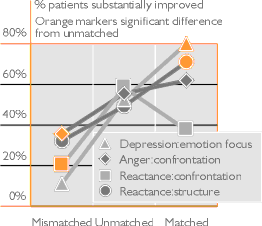
Compared to neutral combinations, some matched combinations (avoiding emotional material with depressed patients; not taking the lead with reactive patients) did indeed lead to significantly less drinking in the following year, reflected in average days abstinent and the proportion of patients substantially improved to the point where they were drinking no more than one day in 20. Rather than dramatic gains, matching optimised already good outcomes.
The effects of being mismatched were more substantial and apparent across all the combinations expected to be detrimental. For example, while around half the unmatched patients substantially improved, for mismatched patients proportions ranged from about 1 in 10 to about a third. Though (perhaps due to small numbers) not always statistically significant, multiple matches were cumulatively beneficial, multiple mismatches cumulatively detrimental. At its peak, when patients were matched on two of the patient-type/therapeutic style combinations, all (but there were just four) substantially improved; mismatched on two, just 1 in 5 did so.
IN CONTEXT The tested combinations were derived from earlier analyses of the same patients. These found motivational interviewing worked relatively well with angry patients because therapists were less directive than when they were training patients in cognitive-behavioural techniques.2 In this US context (where the approach is second nature to many patients), 12-step therapists too had been relatively non-directive and also did well with angry patients. Despite their tendency to obstruct, given a non-directive therapeutic style, 'reactive' patients did as well as the more cooperative.3 But when therapists attempted to be directive either in the structure of the sessions or their content, these patients went on to drink more.4 Patients prone to anger (not the same as the autonomy-striving of reactive patients) reacted badly only to the more overtly confrontational styles of therapists who imposed content in the form, for example, of un-asked for interpretations and challenges. But without this provocation, less highly strung patients actually ended up drinking more than their angry peers. Patients with clinically elevated depressive symptoms later drank less when the therapist avoided focusing on painful emotional material, more when the therapist did the reverse.5 Similar findings have emerged from studies of different therapies and different kinds of patients.6 7 8 9
PRACTICE IMPLICATIONS Cumulatively this evidence is strong enough to support a non-directive therapeutic style with clients whose anger or defensiveness would otherwise lead to a counter-productive reaction, but to be more structured and directive with clients who welcome being given a lead. The Providence studies also suggest that depressed mood is an indication to avoid emotionally painful material. Ability to sense these signals and adjust accordingly could be one way empathic and socially skilled therapists improve outcomes. Some of these adjustments could be formalised on the basis of an initial assessment of the patient or their behaviour in early counselling sessions. Clinical supervision could then be used to encourage a more suitable therapeutic style or to revise client allocation. However, the complexity of multiple and potentially contradictory patient-style matches may defeat attempts to codify the practice of skilled therapists. For example, in one study, the biggest influence on drinking outcomes was not directiveness, but whether therapists addressed the emotional states of highly distressed patients.6 Had they failed to do so for fear of being too directive, they might have done more harm than good.
1 FEATURED STUDY Karno M.P. et al. Does matching matter? Examining matches and mismatches between patient attributes and therapy techniques in alcoholism treatment. Addiction: 2007, 102(4), p. 587–596.
2 Karno M.P. et al. What do we know? Process analysis and the search for a better understanding of Project MATCH's anger-by-treatment matching effect. Journal of Studies on Alcohol: 2004, 65(4), p. 501–512.
3 Karno M.P. et al. Less directiveness by therapists improves drinking outcomes of reactant clients in alcoholism treatment. Journal of Consulting and Clinical Psychology: 2005, 73(2), p. 262–267.
4 Karno M.P. et al. An examination of how therapist directiveness interacts with patient anger and reactance to predict alcohol use. Journal of Studies on Alcohol: 2005, 66(6), p. 825–832.
5 Karno M.P. et al. Patient depressive symptoms and therapist focus on emotional material: a new look at Project MATCH. Journal of Studies on Alcohol: 2003, 64(5), p. 607–615.
6 Karno M.P. et al. Interactions between psychotherapy procedures and patient attributes that predict alcohol treatment effectiveness: a preliminary report. Addictive Behaviors: 2002, 27, p. 779–797.
7 Gottheil E. et al. Effectiveness of high versus low structure individual counseling for substance abuse. American Journal on Addictions: 2002, 11, p. 279–290.
8 Thornton C.C. et al. High- and low-structure treatments for substance dependence: role of learned helplessness. American Journal of Drug and Alcohol Abuse: 2003, 29(3), p. 567–584.
9 Thornton C. et al. Coping styles and response to high versus low-structure individual counseling for substance abuse. American Journal on Addictions: 2003, 12, p. 29–42.
Last revised 09 April 2008 Comment on this entry Give us your feedback on the site (one-minute survey)
Adjust therapist directiveness to client resistance STUDY 2006
My way or yours? REVIEW 2006
Therapist directiveness is an important influence on outcomes STUDY 2005
Patient reactance as a moderator of the effect of therapist structure on posttreatment alcohol use STUDY 2009
Alcohol-use disorders: diagnosis, assessment and management of harmful drinking and alcohol dependence REVIEW 2011
Still hard to find reasons for matching patients to therapies STUDY 2008
Brief motivational therapy minimises health care costs except among more problematic drinkers STUDY 2001
Shared decision-making: increases autonomy in substance-dependent patients STUDY 2011
Cohesion in group therapy: a meta-analysis REVIEW 2018
Counselling: style matters STUDY 2003