 Your selected document
Your selected document
Your selected documentThis entry analyses studies selected by Drug and Alcohol Findings as particularly relevant to improving outcomes from drug or alcohol interventions in the United Kingdom. Entries are drafted by Findings after consulting related research, study authors and other experts. Many were distilled from an extended review. If applicable this can be viewed via the Background notes link at the end of the entry. Entries are © Drug and Alcohol Findings. Permission is given to distribute this document unamended or to incorporate passages in other documents as long as the source and copyright owner are acknowledged including the web address http://findings.org.uk. Links to source documents are in blue. Hover mouse over orange body text for explanatory notes.
Bacterial infections at the injecting site are an everyday experience for drug injectors and a common (but not the only) cause of abscesses. A pus-filled cavity resulting from inflammation. Consequences can include loss of limbs and death if infection spreads. Findings from new US study suggest that needleexchangexs which make adequate supplies of injecting equipment easily accessible not only prevent viral infections but also abscesses. More restrictive policies are less effective and may end up costing health services more than they save.
FINDINGS Conducted in Eureka, California, the featured study1 analysed records from the area's needleexchangex and of abscesses treated at local health centres from the start of 2002 to the end of February 2004. This period straddled the introduction in April 2003 of a more restrictive policy at the needleexchangex. Walk-in one-for-one exchange combined with advice and health care was capped to a maximum of 100 needles per visit, for which appointments were now required. Afterwards the number of visits made to the exchange and the number of needles exchanged both fell, the latter from on average 3268 a week to 471. At the same time the average number of abscesses treated rose by six a week to just over 14.
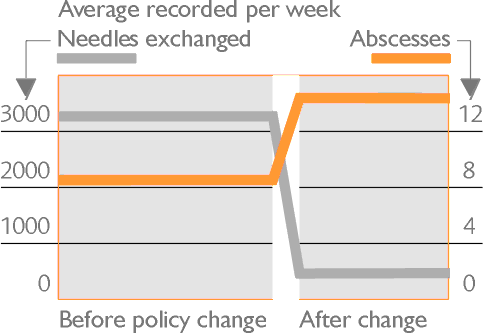
These trends were closely and highly significantly related; the fewer needles exchanged, or the fewer visits in a week, the greater the number of abscesses. Put the other way round, every extra 1000 needles exchanged or every extra eight visits were associated with one fewer abscess. The result was that the exchange's saving of about $243 a week on injecting equipment was overshadowed by at least an extra $500 a week spent elsewhere treating abscesses.
A survey of 62 former injectors recruited through local mutual aid meetings also found that the more needles they had exchanged per visit, the fewer abscesses they had suffered.
IN CONTEXT Findings at this exchange might have been so clear cut because it served a rural area. Possibly this offered few alternative sources of sterile equipment to counteract the exchange's policy switch, and made it easier to identify the rise in abscesses at neighbourhood health centres. Also, the switch was dramatic. The appointment regime seemed to cut visit numbers at the same time as the quantity cap limited per visit supplies, combining to cut supplies by 86%. Despite some shortcomings The analysis based on needleexchangex and health service records seems convincing but would have been more so had there been an attempt to eliminate other potential reasons for the upsurge in abscesses. The survey of former injectors is at best a weak reinforcement of the findings. In this brief report, the economic analysis – not planned in to the study from the start – is not described in detail and seems to have accounted only for equipment costs at the exchange. in the study, the consequence seems to have been to expose a relationship between abscesses and the adequacy of needleexchangex provision which might otherwise have remained hidden.
Which elements of that provision were critical is unclear. Probably frequent health checks/advice and adequate access to sterile equipment were both influential. Other research Reviewing this research comprehensively is beyond the scope of this entry. Only recent studies which specifically referred to abscesses are cited here or in the background notes. indicates that the mechanisms via which needleexchangexs might prevent abscesses include reducing use of potentially contaminated equipment, reducing the re-use of one's own equipment, and improving injecting technique, particularly hygiene.
Among the risk factors identified in a review of bacterial infections in drug users were:2 injecting cocaine or heroin and cocaine mixtures (in both cases due perhaps to cocaine's vasoconstrictive effects and in the former also to very frequent injection); skin popping as an injection technique (concentrating irritants and any bacteria in surface tissue rather than directly injecting in to the blood stream); not cleaning the skin at the injection site and other forms of poor hygiene such as licking needles; repeatedly drawing blood back in to the syringe before injecting ('booting' or 'flushing'); injecting with unclean equipment; sharing potentially contaminated equipment; and contaminated or particularly irritating drug mixtures.
Recent studies (see background notes for details) have confirmed many of these risks. These include a British survey which identified increased crack cocaine injecting as a possible cause of a recent rise in the number of injectors suffering bacterial infections at injection sites.3 One particularly well constructed US study found that the only practice which seemed positively protective against abscess was cleaning the injection site with alcohol before injecting.4
Previous work in California In this study the 'raw' number (ie, unadjusted for differences in caseload) of abscesses did not differ much between different types of exchange policies, but the figures were expressed in terms of the proportion (about 40%) of visitors who had experienced any such injury in the past year, not their frequency or severity. (featured in Findings5) showed that more liberal needle exchange equipment supply policies reduce some of these risk factors by reducing sharing and the re-use of one's own equipment.
Those findings are consistent with a Scottish study which found that inadequate supplies and inconvenient access meant that re-use of one's own equipment was common.6 Beyond this, laboratory tests led the researcher to conclude that the best ways to reduce health risks were to encourage hand washing before injections and to provide acidifiers, filters and single-use vessels for heating the drug solution, with appropriate education in their use.
PRACTICE IMPLICATIONS Indicative of the scale of the problem in the UK, surveys conducted within the past three years have found that a substantial minority (around a third) of injectors attending drug harmreductionx and treatment services have current or recent infected or non-infected abscesses.3 6 7 Treating these and their complications is expensive, often requiring operating theatre time and two or three days of inpatient hospitalisation.4
Subject to confirmation from other studies and other types of studies, the messages from the research seem to be that abscesses and bacterial infections should be reduced by adequate supplies of needles and syringes combined with other equipment (alcohol swabs, acidifiers, filters and 'cookers') plus well-informed, detailed and well-communicated advice on how to maintain hygiene and reduce risks.
Reliance in the UK on pharmacy-based exchanges limits the degree to which all this can be provided.8 9 Compared to exchanges in services dedicated to drug users, in pharmacies there is less likely to be the space, time, inclination or staff training required for this work. However, there is potential for allying pharmacy exchanges with drug specialist provision to ensure access across an area (if not at every exchange) to adequate preventive services.
Specialist provision itself often needs upgrading in terms of both equipment supply and assessments and advice. In England a third of the services which responded to a survey said they did not include injecting hygiene in the initial assessment and 29% did not provide face-to-face harmreductionx advice.8 Access to sterile injecting equipment from exchanges of whatever kind fell well short of the level needed to permit use of a fresh needle each time (on average one syringe every two days) and only a minority provided some other equipment such as sterile water. Similarly if not more so in Scotland.9
Thanks for their comments on this entry in draft to Jenny Scott of the University of Bath. Commentators bear no responsibility for the text including the interpretations and any remaining errors.
1 FEATURED STUDY Tomolillo C.M. et al. The damage done: a study of injection drug use, injection related abscesses and needleexchangex regulation. Substance Use & Misuse: 2007, 42, 10, p. 1603–1611.
2 Gordon R.J. et al. Bacterial infections in drug users. New England Journal of Medicine: 2005, 353, p. 1945–1954.
3 Health Protection Agency [etc]. Shooting up: infections among injecting drug users in the United Kingdom 2006. Health Protection Agency, 2007.
4 Murphy E.L. et al. Risk factors for skin and soft-tissue abscesses among injection drug users: a case-control study. Clinical Infectious Diseases: 2001, 33, p. 35–48.
5 Drug and Alcohol Findings. Needle exchange coverage key to reducing infection risk. 14 February 2008.
6 Scott J. Safety, risks and outcomes from the use of injecting paraphernalia. Scottish Government Social Research, 2008.
7 National Treatment Agency for Substance Misuse (NTA). Harm reduction findings from the NTA's 2006 survey of user satisfaction in England. NTA, 2007.
8 Abdulrahim D. et al. The NTA's 2005 survey of needleexchangexs in England. National Treatment Agency for Substance Misuse, 2007.
9 Griesbach D. et al. Needle exchange provision in Scotland: a report of the National Needle Exchange Survey. Scottish Executive, 2006.
Last revised 07 August 2008 Background notes Comment on this entry Give us your feedback on the site (one-minute survey)
Needle and syringe programmes DOCUMENT 2014
Estimating the cost-effectiveness of needle-syringe programs in Australia STUDY 2012
Prevention and control of infectious diseases among people who inject drugs DOCUMENT 2011
Drug Treatment Matrix cell D1: Organisational functioning; Reducing harm MATRIX CELL 2017
Drug Treatment Matrix cell E1: Local and national systems; Reducing harm MATRIX CELL 2017
Optimal provision of needle and syringe programmes for injecting drug users: a systematic review REVIEW 2010
Hepatitis C and needle exchange part 2: case studies REVIEW 2003